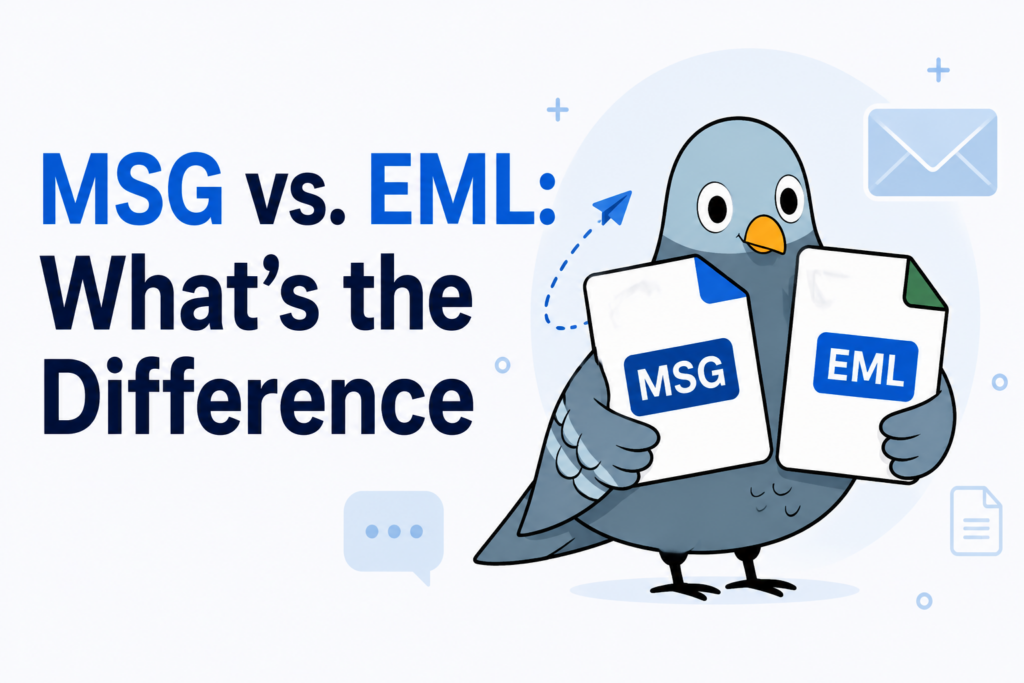
MSG and EML are both ways of saving a single email as a file, but they come from different origins and are built differently under the hood.
Where each format comes from
MSG is Microsoft Outlook’s own format — proprietary, and built around Outlook’s internal data structure. EML, by contrast, is based on an open internet standard (RFC 5322) for representing email messages, which is why most non-Outlook email clients — Apple Mail, Thunderbird, Gmail’s export, and others — use it instead.
The structural difference
An EML file is essentially plain text: headers and body in a readable format, which is why you can technically open one in a text editor and make sense of it. An MSG file is binary — built on the same compound file structure Microsoft historically used for legacy Word and Excel files — so it isn’t human-readable without the right software. For more on what’s actually inside one, see what is an MSG file.
Does the difference matter when converting to PDF?
Not really, from a practical standpoint. Both formats contain the same core information — sender, recipients, subject, body, and attachments — just packaged differently. A converter built to handle both reads whichever structure it’s given and produces the same kind of PDF output either way.
When you’d need one over the other
The format you end up with usually depends on where the email came from, not a choice you make. Emails saved or forwarded from Outlook typically come as MSG; emails exported from most other clients come as EML. If you’re moving between email systems, EML is generally the more portable option since more software reads it natively.
Can you convert MSG to EML, or vice versa?
[Confirm: this tool converts both MSG and EML to PDF, but doesn’t currently convert between MSG and EML themselves — worth stating plainly rather than leaving ambiguous, since it’s a reasonable thing to assume is possible.]
The bottom line
If your goal is just getting a readable, shareable file, the format you start with doesn’t change much. This converter accepts both .msg and .eml files and produces the same PDF output regardless of which one you have.